

5 Things Your Eye Doctor Wants You to Know During Your Refraction
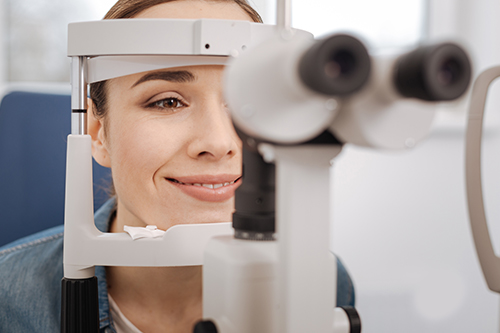
“Which is better — 1 or 2?” That simple question is the backbone of one of the most important parts of your eye exam. Here’s how to make the most of it.”
Refraction is the clinical term for the process where your doctor presents you with different lens choices to determine your glasses prescription. It sounds simple, but your feedback during this test directly shapes what ends up in your frames. Done well, it produces a crisp, comfortable prescription. Done with a few common pitfalls, it can leave you with glasses that never quite feel right.
These five tips will help you be a better partner in the process — and get you to your best vision faster.
1. Pick the choice that looks clearer — not darker or bigger
This sounds obvious, but clarity can mean different things to different people — and the wrong
interpretation can throw off your prescription. What we’re looking for is that letters become more defined, crisper, and easier to identify. That’s it.
If one choice makes letters look darker, bolder, or larger, that’s not clarity — that’s a sign the lens has
too much minus power. A common instinct is to prefer the “stronger-looking” option, but in optics, stronger isn’t always better. Aim for sharpness, not intensity.
Ask yourself: “Are the edges of the letters crisper?” — not “Does this look more dramatic?”
2. Your eyes’ focusing system can work against you
Your eyes have an internal focusing muscle — the ciliary muscle — that constantly adjusts to keep things sharp. During a refraction, this muscle can involuntarily kick in and skew your responses without you even realizing it.
This is especially common in younger patients and people with higher prescriptions. When a lens choice suddenly makes everything look very sharp but also darker and higher-contrast, it often means the prescription has gone past the sweet spot and your eye is compensating. If something feels off, say so – it’s valuable information.
Tip: Relax your gaze as if you’re looking at something far away, even while reading the chart.
3. Keep both eyes open — even when we’re testing one
It’s a natural instinct to squeeze the uncovered eye shut during a monocular test. Please don’t. When you close an eye, several things can compromise the test:
The closed eye loses its natural resting focus state, making accurate assessment harder when we switch to it. Physical pressure from squeezing the lid can temporarily distort vision. And when you reopen, the sudden light change causes the eye to readjust. Let the occluder do the work — your job is to look straight ahead and stay relaxed.
4. Your prescription is a treatment — and sometimes it needs fine-tuning
A glasses prescription isn’t just a number we write down — it’s a clinical treatment for how your visual
system functions. And like any treatment, it occasionally needs to be adjusted.
Sometimes a prescription that tests perfectly in the exam room causes headaches, distortion, or eye strain in the real world. This can happen due to changes in your posture, dominant eye, or how your frame fits. It doesn’t mean the exam was done incorrectly — it means we’re iterating toward your optimal correction.
Don’t hesitate to come back if something feels off.
5. We have more than one way to find your prescription
The “1 or 2” test gets all the attention, but it’s just one piece of the puzzle. We also use:
Autorefraction — an automated device that gives us an objective starting estimate before the subjective test begins.
Retinoscopy — a technique where the doctor shines a light into your eye and observes the reflection to neutralize your prescription without any input from you.
These methods are especially critical for young children, patients with communication challenges, or anyone who finds it difficult to reliably compare options. Your verbal answers help us refine the prescription — but they’re never the only data we rely on.
Parents: even if your child can’t sit still for the full refraction, we can still get an accurate prescription using objective techniques.
Getting a great glasses prescription is a team effort. Your honest, relaxed feedback — even a simple “I’m not sure, they look similar” — is more useful than a guess.
Questions about your prescription or your next exam? We’re always happy to talk through it.



Contact Info
© 2026 Great Lakes Optometry. All rights Reserved. Accessibility Statement - Privacy Policy - Sitemap
Designed & Managed By:
